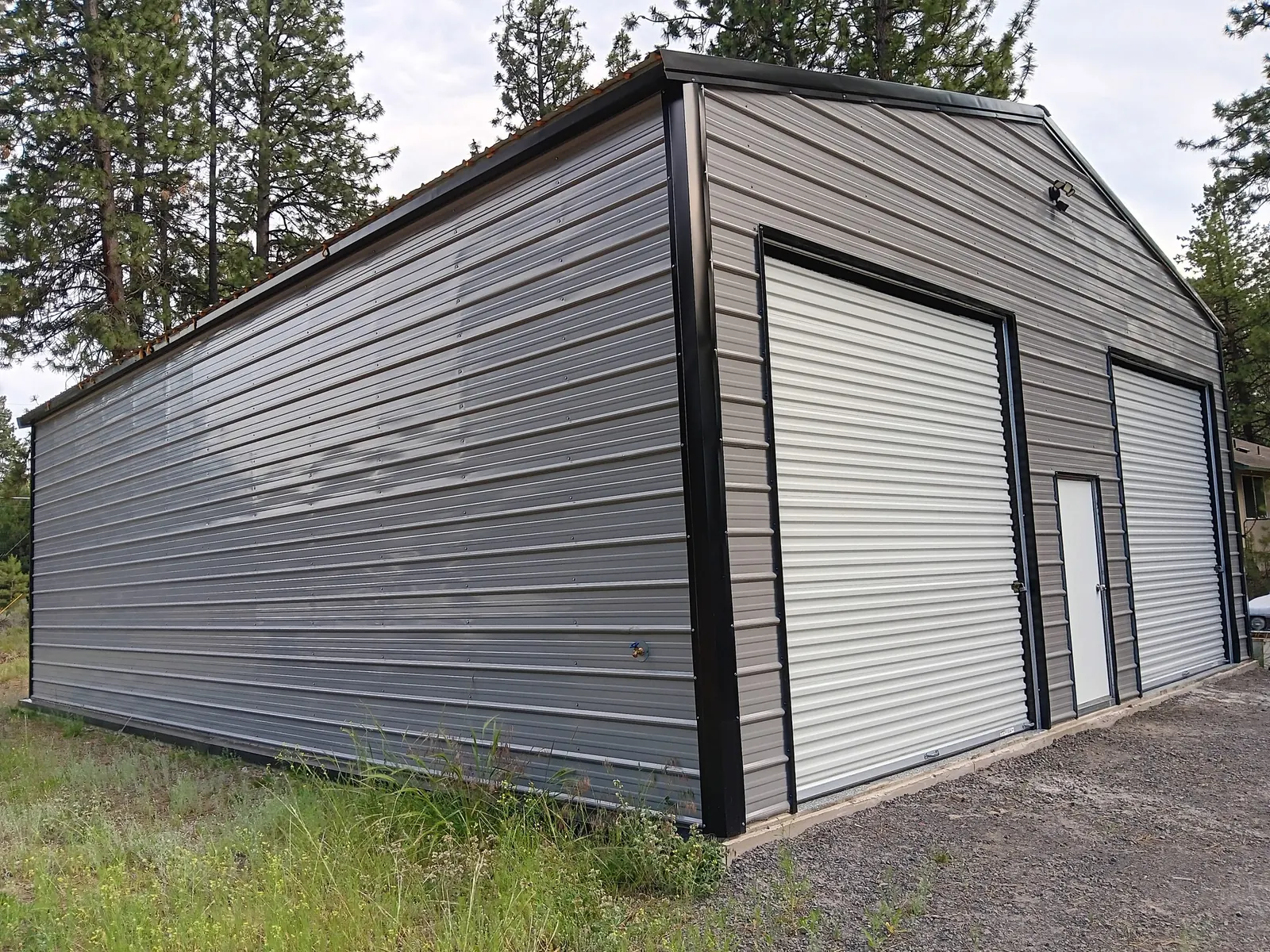
People ask me which is better for a metal building, a concrete slab or a gravel pad. The honest answer is that it depends on what you are putting inside and what your ground does in winter. Both work. Both can fail if the prep is sloppy.
What most buyers don't know
The steel building does not need the slab to stand up. A metal garage or shop is anchored to the ground along its base, and the anchors are chosen for the surface underneath. What the slab does is give you a floor. So the question is really "do I want a floor, and is my ground ready for either one?"
If the ground is not ready, a slab does not fix that. It just hides the problem until the first hard winter.
When concrete makes sense
If you are building a metal shop with roll-up doors and a walk-in door and you plan to work in it, concrete is hard to beat. You can roll a toolbox across it, drain a floor, run a lift, and sweep it out. A welding table, a vehicle lift or a tractor with a loader all want a slab.
Concrete also pairs well with insulation. If you plan to heat the building, a slab gives you something to seal the wall panels against, which cuts drafts and keeps mice out.
For a slab, the thickness, rebar and edge all matter, and the plan should come from whoever pours it. Ask them about footing depth for your area. In Bend, Sisters and Redmond the ground freezes and thaws all winter. In Spokane and the Idaho panhandle the frost goes deeper.
When gravel is the smart call
Gravel is a good fit for a barn, a hay shed, storage, or any building where the floor is going to get dirty anyway. It drains well, it is easier to fix than a cracked slab, and you can add a slab later if the use changes.
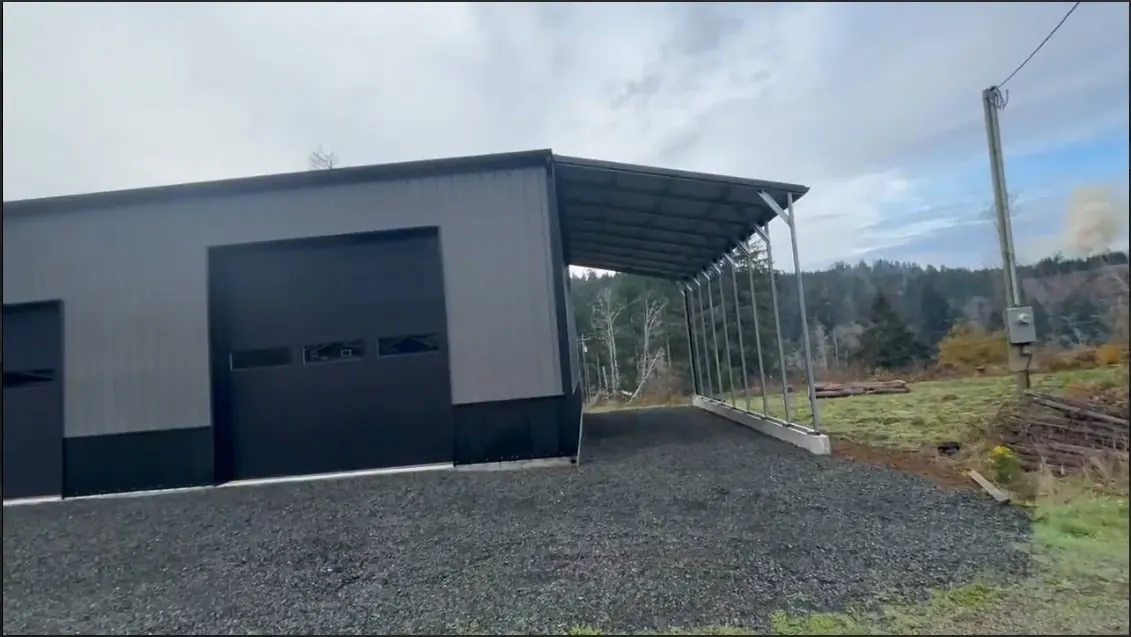
Good gravel does not mean dumping a load and spreading it. You want the topsoil stripped, a compacted base of crushed rock, and a surface that sheds water away from the building on every side. Pea gravel and loose river rock are not a good base. They shift under a vehicle.
Things that matter either way
Level. A building that goes up on an out-of-level pad can be shimmed only so far. Roll-up doors and the walk-in door are the first things to bind when the pad is off. Get the pad flat and check it corner to corner before the crew shows up.
Drainage. Water is the real enemy. In the Willamette Valley and along the coast it comes from above. In Central Oregon and eastern Washington it comes from snowmelt in spring. Either way, the pad should sit a little higher than the ground around it, with a path for water to leave.
Access. Delivery trucks and the install crew need a way in. A soft driveway, a narrow gate, or low power lines can hold things up. Walk the route before the build date.
Size of the pad. Make it a bit bigger than the building. A pad cut exactly to the footprint leaves no room for the crew to set up and no apron in front of the doors.
Permits and the pad
The pad is often part of what your county looks at. A slab typically gets inspected before the pour, and some counties want a plan for the footing. Deschutes County, Crook County and Jefferson County each have their own planning and building offices, and the rules differ on size, setbacks and use. Washington and Idaho work the same way with different offices. Call the building department with your address before you pour anything. A slab poured before the permit is sorted out is one of the most expensive mistakes I hear about.
Side additions and open side bays
If you plan to add a side addition or an open side bay for equipment, think about it when you lay out the pad. Adding concrete next to an existing slab later is possible, but matching grade and drainage is harder than doing it once. A gravel apron under an open side bay is a common, practical answer.
How I would decide
- Working shop, heated, with vehicles or tools: concrete.
- Barn, storage, or equipment shelter: compacted gravel.
- Not sure yet: a well-built gravel pad now, and a slab later if the use calls for it.
- Clay, or ground that stays wet: talk to a local excavator first. Drainage matters more than the surface.
Whichever way you go, tell us what surface you have when you order. The anchoring is picked to match, and a certified building is engineered with that in mind. If the surface changes after the order, the anchoring has to change with it.
The pad is the one part of the job you control completely before the crew arrives. Do it right and the rest goes quickly.